




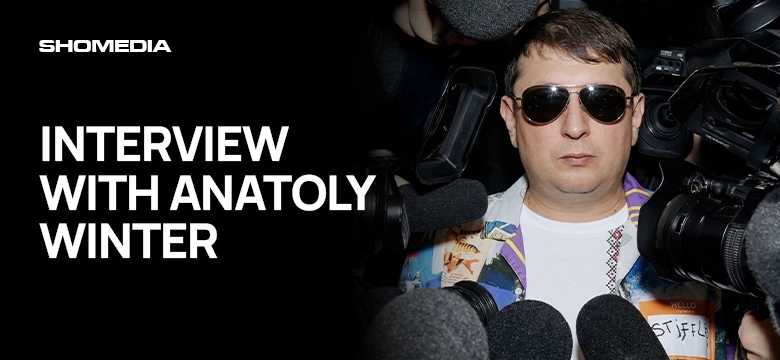
Anatoly Winter entered affiliate marketing in 2000, when he was just 16. He started by building his own websites and generating free traffic, then experimented with traffic arbitrage a few years later. Today, he runs WintEvents and is preparing the Search iGaming Conference, focused on search traffic.
In this SHO MEDIA interview, we spoke with Anatoly Winter about his first online earnings, turning WintEvents from a hobby into a profitable business and launching the new SIC conference. We also discussed competition in the events market, attracting high-level attendees and two occasions when organizers had to save an event on the fly.
Hi, you started buying traffic back in the 2000s. How did you even get the idea to enter traffic arbitrage when the term didn't exist yet?
I started in affiliate marketing in 2000, when I was 16. What I was doing at first was more about creating my own websites.
My first attempts at traffic arbitrage came around 2003-2004.
My motivation was pretty standard - I wanted to earn enough to have a normal life independent of my parents. Given my age and lack of serious experience, there was no way to make decent money as an employee, and I didn't want a regular job anyway)
I had actually worked as an employee at 14 as an 'IT handyman' (that was a popular name back then for the company IT guy who helped everyone with both software and hardware). Although the office and the team were great, I didn't really like working under someone else's prescribed rules)
At first, I tried finding odd jobs online, such as transcribing dictaphone recordings from seminars. I'd been able to type very fast without looking at the keyboard since I was young)
But the earning potential there was also very limited)
So I started looking for a way to earn properly on my own. With my good understanding of hardware and computer networks, it was clear that the internet was the most realistic option for me)
And money had to be where other people were paying for something.
So I started throwing together little websites on free hosting services, placing affiliate ads on them and driving traffic from free sources.
For the first two months, I tried all sorts of things, barely left the house and earned just $15. I was close to giving it all up, but then I found some approaches that worked well and started making excellent money for my age and for that time) And things took off)
In another interview, you said that in the 10 years WintEvents has existed, it only became profitable in the last two years, and before that it was more of a hobby. What specific steps helped turn a profit?
Actually, the steps were pretty ordinary - we introduced management and budget planning, financial reporting, a better team incentive system, reassessed risk management and decided to almost completely eliminate money-losing events.
That's the main thing.
For many years we operated without any P&L at all. Then for several more years we only put it together at the beginning of the next year for the previous year, and were surprised by the numbers 😄 It was a very creative process, not exactly what you'd call a business.
Once we decided this should be a business and not just a hobby we loved, we made those fairly straightforward management decisions, and things improved significantly.
Events have never been my primary source of income, and they still aren't. Perhaps that's why we treated the business side of things somewhat casually for so many years)
But at some point I realized that I couldn't afford an unprofitable or even loss-making hobby that took up so much of my time) And I didn't want to give up events.
I had to change my attitude, and the results improved quickly afterward.
Our net profit for 2025 was approximately seven times higher than in 2024. The figures are still fairly modest overall, but the trend is good, and I think we'll make another significant step forward in 2026.
What does WintEvents look like as a business today?
We still have a small full-time team, but like a construction set, we expand considerably when we take on large projects.
We produce our own events (ANS, Grand Party and now the SIC conference), organize events for clients as contractors, and help companies present themselves at trade shows (booths and everything that goes with them).
We're interested in all of those areas. We're also always open to potential partnerships.
How did you decide to launch your own conference?
We already had experience as co-organizers of three conferences in Kyiv (two MAC conferences in Kyiv and Kinza), and for a long time we'd wanted to create and develop a new conference brand in the affiliate industry.
What prevented us from doing it earlier were 'black swan' events (the pandemic and the war), as well as our reluctance to take a substantial loss right at the start, which often happens with new conferences.
Now a number of circumstances have lined up well.
Sasha Flint and I independently came up with the idea that the iGaming industry lacked a major SEO conference, even though SEO is one of the largest sources of high-quality traffic.
There are some smaller conferences with good content and strong participants, but without expo areas and not on the scale that could be achieved.
We decided to fill that gap and hold regular conferences (we plan twice a year in different countries) with a full-scale expo area and more than 1,000 attendees at the very first event.
We expanded the topic from SEO to all the major forms of search traffic (SEO, ASO and PPC search ads). In my view, it's turning into something remarkable in terms of content quality, usefulness and who is attending.
Even before making public announcements, we invited a large number of strong teams working with those traffic sources and received confirmation that they'd attend, as well as a huge number of strong experts interested in speaking.
Now Sasha (Flint) is scratching his head over how to fit more excellent talks into the program)
So far, we get the feeling we weren't wrong about there being a gap in the affiliate events market for this subject.
It feels like there are endless affiliate conferences now - every month there are events in Dubai, Thailand, LatAm and Europe. What's your special angle in such a competitive market?
There really are a lot of conferences, and we didn't want to create another one 'just like everyone else's'.
Our differentiator is simple - it's our focus on search traffic and top experts in those sources, both among speakers and conference attendees.
It's extremely important to us that SIC (Search iGaming Conference) has a genuinely strong lineup and speaker content that's valuable not just to newcomers but also to people with extensive experience.
That's one of our key priorities.
Some affiliate conferences (we won't name names) have recently started attracting crowds of low-budget participants, which booth buyers really dislike. Do you have mechanisms to ensure a high concentration of genuine industry leaders?
We personally invite top teams to fly in for our conference, and most accept and promise to attend.
I think that's thanks both to the conference topic being genuinely in demand and, of course, to the personal contacts, friendships and partnerships that Sasha Flint and I have built over many, many years in the industry.
That gives us a very strong core of speakers and conference attendees.
We don't offer free tickets to random people off the street.
Of course anyone can buy a ticket and attend; we sell SIC tickets without pre-screening. But I think the conference's strong specialization and its core of top-level participants will allow us to bring together a very high percentage of people who genuinely know the topic, as well as those who want to buy their traffic or sell them a service.
I expect the vast majority of people at SIC to be genuinely interesting to one another and have things worth discussing, with only a very small proportion of random visitors.
And finally, tell us about the most epic behind-the-scenes event disaster that guests never realized had happened because your team managed to fix everything.
Actually, my most epic event disasters happened before WintEvents was founded)
Back in the 2000s, during my first experiments with large-scale events, we once planned a very impressive transfer. We'd booked a private VIP train with three carriages to take our guests from a major public railway station to a station outside the city near the event venue.
We'd laid out a fantastic spread of drinks and snacks on the train and covered it with branding. Everything was prepared to make a great impression.
But we wanted to surprise the guests and create a contrast, so first we put them on old, beat-up buses without air conditioning in 30+ degree heat. We wanted them to think they'd be spending hours stuck in traffic in those awful, stuffy conditions on the way out of town.
The plan was to drive only 5-10 minutes to the station (it was really close by), then wow them with the train.
But because traffic was genuinely terrible, the buses arrived to collect us extremely late. Then, as soon as we set off, we got stuck in a complete standstill and realized we wouldn't reach the station in time. The train would leave without us. Trains don't wait; they run on strict schedules, especially from a station with a huge number of suburban departures.
So we had to make an extreme decision: take all our guests into the metro during rush hour to travel one stop.
The metro was packed, our guests had already had a few drinks, and many of them had never even been on a metro before. We had no tickets. It was chaos)
I thought we'd lose about 10-15% of our guests and have to track them down individually afterward and drive them to the venue separately.
But a miracle happened - we didn't lose a single person (out of approximately 120). We traveled one stop by metro and reached the platform at exactly the moment our train was pulling in.
It worked out so spectacularly that the guests were convinced the metro trip had been part of the plan all along. They absolutely loved it.
I honestly tried to explain that it had been an emergency and things were supposed to happen differently, but they didn't believe me)))
I had another epic disaster before WE, when the host simply failed to show up for an event without warning us beforehand. The host had a huge role in that event, and much of the program depended on him.
It was extremely difficult to recover, and the program went completely off plan. But once again most guests never noticed and had a great time; many praised and thanked us for the event afterward)
At WintEvents we haven't had disasters quite that extreme. The failures have been much less dramatic, and only a handful of guests noticed them.
For event attendees, what matters most is the overall atmosphere and the people they meet. Guests won't notice the details of individual failures unless those failures cause them some obvious personal inconvenience.
Комментарии